If your short-term rental has a tax loss, you may be able to deduct it against wages or other income. The answer depends partly on how long guests stay and how much work you do. Other deduction limits also apply.
Material participation means meeting an IRS test for your involvement in the business. Owning the property is not enough. You need to show what work you did and, for some tests, how your hours compare with other people's hours.
Check how long your guests stay
Rental losses are usually treated as passive losses, which generally cannot reduce taxes on wages. Short stays can change which rules apply.
If the average guest stay is seven days or less, the activity generally falls outside the rental category for these tax rules. You then use the material participation tests to determine whether its losses are passive. You do not need real estate professional status to use this exception. Read the rental-activity exceptions.
For one property treated as a separate activity, divide the total days in guest stays by the number of stays for the tax year. For example, 180 days across 45 separate stays gives a four-day average.
Use the actual periods guests had use of the property. Extending a booking or making consecutive reservations may still count as one stay. Ask your tax advisor how to handle stays crossing December 31 and multiple properties. See the calculation rules.
An average above seven days does not automatically rule you out. Another exception applies when stays average 30 days or less and you provide significant personal services. Have your advisor check whether this or another exception fits your rental.
The seven material participation tests
You generally need to meet one test, not all seven. Count only work that qualifies under the rules. Limited partnership interests have additional restrictions. These summaries follow Treasury Regulation 1.469-5T.
You worked more than 500 hours. Count your qualifying work in the activity during the tax year.
You did substantially all the work. Compare your work with everyone's work, including paid workers. The rule does not give a fixed percentage for "substantially all."
You worked more than 100 hours, and no other person worked more than you. Compare your hours with each individual, including paid workers. A tie is allowed.
Your work across several activities exceeded 500 hours. Each must be a qualifying trade or business activity in which you worked more than 100 hours. Leave out any activity that already meets another material participation test. These are called significant participation activities.
You qualified in five of the previous ten years. You materially participated in this activity in any five of those ten tax years.
You materially participated in a personal service activity in any three previous years. This applies to certain service businesses, such as health, law, or consulting, and other businesses where invested money or property does not contribute significantly to income. It generally does not fit a property rental business.
Your work was regular, continuous, and substantial. This test depends on the facts and requires more than 100 hours. You cannot count management time under this test if someone else was paid to manage the activity or spent more time managing it than you did.
Exactly 100 hours is not enough for test 3. Exactly 500 hours is not enough for test 1. Meeting a test does not remove the other limits on deducting a loss.
Compare hours one person at a time
For test 3, you must work more than 100 qualifying hours and at least as many hours as each other person. You do not compare your hours with all workers' hours added together.
Here is a fictional example for one tax year.
Person | Hours |
|---|---|
Owner | 130 |
Cleaner | 120 |
Co-host | 60 |
Repair technician | 20 |
The owner meets test 3 in this example, assuming the hours qualify. If the cleaner had worked 150 hours, the owner would not meet this test. Another test might still apply.
Keep a separate total for each person. A cleaning company's total alone will not show how many hours each cleaner worked. Save schedules, invoices, or other records that support your comparison, and label estimates as estimates.
Your spouse's work counts toward your material participation, even if your spouse does not own the property or you file separate returns. Record who did each task. Read the spouse participation rule.
Keep a useful time log
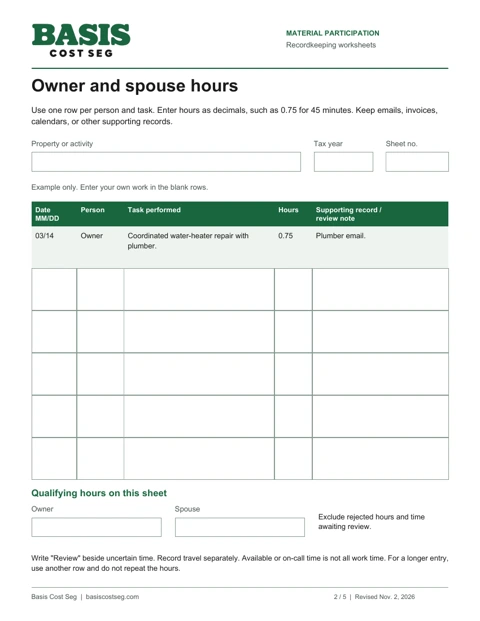
For each entry, record:
The date and property.
Who did the work.
What they did.
How much time it took.
A supporting record, such as an invoice, message, or calendar entry.
Describe the task specifically. "Coordinated a plumbing repair and confirmed guest access" says more than "property management." Record the time you spent working, not the whole period you were available to help.
Not every property-related task counts. Reviewing financial statements as an investor generally does not count unless you are directly involved in daily management or operations. Work an owner would not ordinarily do, done mainly to avoid the passive loss limits, can also be excluded. Mark uncertain entries, including travel, for your advisor to review. See IRS Publication 925.
A daily log is not required. Calendars and written summaries can also provide reasonable evidence. Recording your work soon after you do it makes it easier to remember accurately. Do not invent hours to fill gaps.
Download the free time log
The Basis Cost Seg form has space for your hours, your spouse's hours, other workers' hours, and guest stays. It also includes a year-end summary and the seven tests.
Download the form before entering information.
Fill it out and save it in your PDF reader. You can also print it and write by hand.
If you filled it out digitally, reopen the file to check that your entries were saved.
Keep it with your tax records and share it with your tax advisor.
You can print extra log pages as needed. Nothing you enter is submitted to Basis. This is a recordkeeping aid, not an IRS form to attach to your return.
Do you need real estate professional status?
You do not need that status if your activity meets the seven-day exception and you materially participate. Real estate professional status is a separate set of rules that can matter when an activity is treated as rental real estate.
To qualify for that status, an individual generally must spend more than 750 hours in qualifying real property businesses and more than half of their total working time in those businesses. Material participation requirements still apply. On a joint return, one spouse must meet the professional-status requirements separately. Spouses cannot combine their hours to reach those thresholds. See Section 469(c)(7).
If a loss is passive, it may still offset passive income or carry forward to a later year. A qualifying sale can also allow previously unused losses to be deducted. Some rental owners who actively participate qualify for a limited allowance, subject to income and other restrictions. IRS Publication 925 explains these rules.
Other rules can limit your deduction
Ask your tax advisor to check:
Personal use. Vacation-home limits can apply if your personal use exceeds the greater of 14 days or 10% of the days rented at a fair rental price. Family stays and below-market rentals can count as personal use. See IRS Topic 415.
Your investment and financial risk. The tax rules for basis and amounts at risk can limit losses before the passive loss rules apply. See IRS Publication 925.
Total business losses. A separate limit can restrict business losses for individuals and other noncorporate taxpayers. See the Form 461 instructions.
Services you provide to guests. Substantial services can affect whether you report the activity on Schedule C and owe self-employment tax. Short stays alone do not decide this. See IRS Publication 527.
How cost segregation fits
A cost segregation study identifies building components and land improvements that can be depreciated over shorter periods. This can move some deductions into earlier years and increase a current-year loss. Land itself cannot be depreciated. The study does not establish material participation or show whether you can use a loss against wages.
The building's depreciation period is a separate question. Residential rental property generally uses 27.5 years under the general depreciation system; nonresidential real property generally uses 39 years. The seven-day rule does not decide which period applies. See our guide to 27.5-year and 39-year short-term rental depreciation and IRS Publication 946.
Current federal law generally allows 100% bonus depreciation for eligible property acquired and placed in service after January 19, 2025. That can allow the full eligible cost to be deducted in the first year. Not every building component qualifies, and acquisition rules and tax elections matter. Earlier acquisitions follow different rules. Read the IRS bonus depreciation guidance.
Get a free cost segregation estimate to explore potential depreciation deductions for your property. Bring the estimate and your time log to your tax advisor to discuss how much you could deduct this year. Taking deductions earlier can also affect taxes when you sell. If you order a study, our CPA review checklist explains which records to bring.
Does hiring a property manager disqualify you?
No. A manager's hours can affect tests 2 and 3, and paid management limits the management time you can count under test 7. You may still qualify under another test, such as working more than 500 hours.
This article provides general federal tax information. Review your rental, records, and deduction limits with a qualified tax advisor. State rules can differ.
Further reading
- Treasury Regulation 1.469-5T The material participation tests and recordkeeping rules.
- IRS Publication 925 Passive activity and at-risk limits.
- IRS bonus depreciation guidance Acquisition and placed-in-service requirements.